By definition, books are made for the future. They solidify knowledge while at the same time generating new ideas. They make sure that the now finds a place where it is accessible to the future. [1]
For the contemporary photobook, reception is a problem easily deferred. Not only are there difficulties in establishing suitable strategies for speaking about experiences and impacts of the medium, but there can also be a reluctance to unsettle the stability and integrity of two pillars on which its postmillennium success has been built.[2] Firstly, there is the confluence of technologies that drastically reduced the barriers to photographic publishing. Encouraged by a “rhetoric of individual vision,”[3] supported by emerging networks, and unrestricted by traditional gatekeepers, more people than ever before have produced photobooks. Secondly, the materiality of the book situates it as an ideal medium to span time. It punctuates the flow of digital content, remains unchanged as it waits to be called into action, and needs no power or machinery external to the body and the mind that reads it. A great surge of material content with no expiry date. As a result, photobooks have frequently been accompanied by descriptions of underlying potential and message-in-a-bottle metaphors.[4] Silja Leifsdottir posits the photobook as a “time capsule of our era” offering an “earthbound parallel” to the Golden Record that accompanied the 1977 Voyager mission into space.[5]
This trust in the latent energy of the photobook—which can "explode into life at any time"[6]—brings about a collective ennui regarding more immediate futures and specific publics. In contrast to the wealth of documentation and conversation that photobook makers contribute to that is concerned with working toward the book, the journey from the book is often met with passivity. It is not that makers are uncaring of their work’s reception, but rather they seem willing to allow the book to be at the mercy and will of its readership. The work is done. Bringing attention to ways in which the contemporary photobook can orchestrate reading scenarios in the present and incorporate response is not to encourage a shift toward a more market-driven sentiment. It can instead simply raise demands on our responsibility to form an “empathy with readers”[7] in established and new audiences.
This empathy, which shares traits with Matthew Stadler’s “reading economy,”[8] is not to be confused with strategies for controlling or encouraging specific reading experiences. Foldout, stick-in, cut-open, and even installation encouragement are not so much examples of works that demonstrate an empathy with readers as they are examples of manners in which makers devise ways to be involved in the reading. These books weave specific reception tactics into production rather than adopt iterative, agile, or community-oriented distribution strategies that can invite and collect response.[9] Here I’d like to focus on the latter and show how a lending library, a distribution model, and a follow-up publication have each extended thought and action regarding reception: firstly witnessing the construction of reception awareness in Manual Editions’ lending library, secondly noting how the personed distribution of Dayanita Singh’s Chairs[10] produces nodal publics, and finally witnessing how response can inform republishing in Hidden Islam: 479 Comments.[11]
Reading rooms, collection displays, archive initiatives, and online group discussion projects can all be counted as attempts to build discourse from the shared experience of photobooks in the relative now.[12] Each is built loosely on principles of formal study, community reading, or library services and deals with books from varied places and publishers. Far less common are instances or strategies adopted by makers themselves that encourage readers to consider their reading in relation to a point in time, or to previous and subsequent readers. The Manual Editions Library is, perhaps accidentally, a notable exception. Manual Editions is the imprint of visual artist and architect Tamsin Green, whose practice leads to “environmentally conscious and handmade photobooks”[13]—books that by their very nature tend toward the limited and expensive. The library, which loans books for a small fee, was thus formed to counter an otherwise inevitable situation in which small and handmade editions result in exclusivity.[14] A byproduct of these actions to aid access and reduce resource consumption is that readers of Green’s loaned books enter into a sequential readership, one in which they are made aware of their particular occasion of reception.

In August 2022, I entered into the chronology of Green’s readers when I received This Is How the Earth Must See Itself for a week at a cost of £10.[15] It is a layered, tactile, almost sculptural book that, much like the landscapes Green is immersed in, lends itself to wandering rather than traversing. For this reason, I was anxious about the defined period during which I was to have the book. My time was relatively short, and awareness of this meant that reading was closely connected with life at the time. I was acutely aware of the moment in which I was reading. What strengthened this feeling was seeing the names of readers before me (six in total at the time)[16] and the spaces for readers who would come after. Like stickers on a summit sign or the penciled highlighting of key quotes in a university textbook,[17] being reminded of my reading as an individual connected with other individuals was powerful. Knowledge of others’ hands on pages and eyes across spreads set up a series of imagined experiences parallel to my own. Shadows that provided an external awareness and networked dimension to an otherwise internal process. I was in a public reaching through time, yet still in my own now.
As Michael Warner argues, there are “several senses” of public. The first is “the public … a kind of social totality,” the second is “a public … a concrete audience” that is “bound by the event or the shared physical space,” and a third is proposed as a public “that comes into being only in relation to texts and their circulation.”[18] In reading Green’s library book I found myself straddling the latter of these three senses, playing a role in the circulation of a text (albeit a single object) and at the same time linked with other readers through a (moveable) physical space. That Green’s simple gesture, which is, and has been, carried out countless times in the borrowing of books from the world’s libraries, may make the assertion obvious but simultaneously alien to the medium in question. That the borrowing of photobooks is worth speaking about says much of an attachment to art-object ownership and market-driven measures of success aligned to production rather than making public. Green’s library serves many purposes. It responds to environmental and accessibility concerns that were the driving force behind the initiative while also helping to generate awareness of reception in relation to others. It serves as a reminder of what photobook makers can do even with expensive and limited works, and it shows how more overt and contrived strategies can further harness the energy of a text.
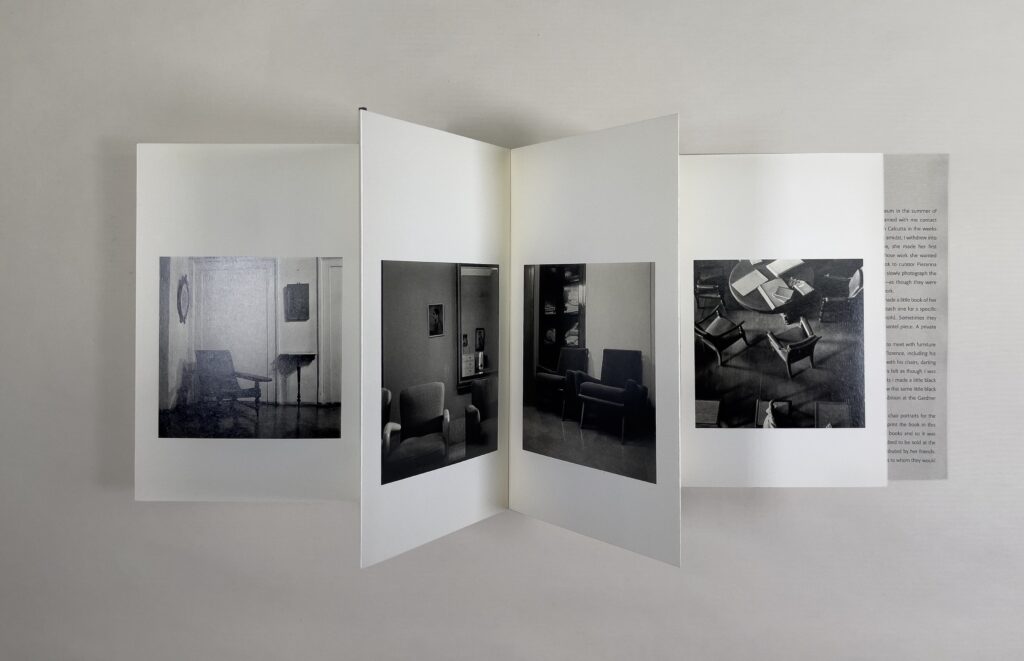
Isabella Stewart Gardner Museum & Steidl, 2005.
3.5 x 5.5 in (9 x 14cm). Edition of 1000.
Accordion fold, 22 tritones.
This Is How the Earth Must See Itself doesn’t ask for response or action, but it sets the scene for this possibility. Should makers be so inclined, it is easy to see how the necessity to communicate with the maker (to arrange postage and times of loan) and the recording of loan (via a simple sheet) could be augmented to generate discussion. Such conversation is hinted at or imagined with Green’s loaned books but becomes real in the case of Dayanita Singh’s Chairs. This accordion book is Singh’s response to an artist residency at Boston’s Isabella Stewart Gardner Museum in which she became fascinated with the chairs of the museum’s collection—they each had their own personalities and “became [her] friends in the museum.”[19] The work, jointly published by the museum and Steidl, was realized in an edition of 1,000, with Singh herself given 500. In turn, these were presented to fifty close friends along with an edition marking, which was unique to each “distributor.”[20] Fifty people, then, each acting as distributor for their own edition of Chairs. Unsurprisingly, there was a “variety of distributing systems and logic”[21] arising from the adoption of personal choice (away from financial necessity) as central to the manner in which books were given. Some works were given to collectors, curators, and artists who distributors thought would enjoy the work, while others were less selective in their approach, using proximity or time as a reason for distribution (for example, giving the book to the first ten people they saw upon the arrival of the books).
Much like the temporary custody of Green’s books, possession of Chairs means the reader is positioned not only in relation to the book but to other individuals chosen by the same distributor, and to the distributor themselves. What’s more, reception of the work begins as an introduction. A gifting. A gesture. Much as we may share a recipe or film recommendation, this introduction can be full of detail and description or instead rely on the quality and trust of a relationship to imbue the text with credibility and value. The book is often spoken of as an imagined meeting place, but for Chairs the book quite literally brings people together. Even for the most cursory of handovers to a stranger, the work is momentarily a physical extension between readers. Aside from almost guaranteeing the successful delivery of the edition to readers (interested or otherwise), this model of personed distribution forms a public of five hundred (bound by experience but far from connected in any other way) and, underneath this, a network of much smaller, nodal publics: each one comprising at least two readers and the text, all linked to Singh’s initial identification of fifty distributors.
Singh’s approach to the distribution of Chairs is not novel within the histories of art and publishing. In fact, it could be said that she replicated via personed distribution the role of the bookshop that Benjamin Thorel (After 8 Books) describes as “gathering people and publications together” to “feed reflection, thought processes, questions, actions [and] decisions at the level of groups and individuals.”[22] Yet to see it adopted for an individual work in the contemporary landscape is surprisingly rare. For many makers, the financial model of Chairs that permitted such a strategy may not be easily replicable, but there are other examples to build on. Publications like Works That Work from Peter Biľak in which the magazine was “socially distributed” by readers who, in “return of the effort, receive 30% of the sale price.”[23] Or Display Distribute’s Light Logistics strategy, which positions reader-buyers as slow couriers for others’ purchases. Elaine W. Ho of Display Distribute describes the project in a way that chimes with Singh’s model, whereby the courier (or distributor) “becomes a physical linkage imbued with other potentiality.”[24] Singh is an outlier in an otherwise startlingly traditional and formulaic photobook publishing landscape. Her realization of works on paper is ever-changing and informed by individual pieces. Nimble. Such flexibility can be seen in her book-as-exhibition works, which set up particular acts and environments of reception, as well as her publishing strategies for works, which have involved a jacket housing the nine volumes of Museum Bhavan[25] and a custom book cart for the sale of House of Love.[26] For Singh, it seems that potentiality alone is not enough. So while she recognizes the latent energy of the book, there is accompanying attention paid to reception in the now and near future, an approach that does not negate the efficacy of patient publishing but acts as a catalyst for more immediate discourse.

introduction by Martin Parr. RORHOF , 2014.
6 x 9.5 in (16 x 24 cm), 90 pages. 2 editions of
1000, 1 edition of 3000.
Green’s and Singh’s interventions into the postpublication life of the book demonstrate ways in which to locate, anchor, and network particular readings, but the evidence of the publics and discourse they create is blurry at best. Existing but difficult to witness. Where this has been flipped on its head is in Nicolò Degiorgis’s Hidden Islam.[27] This book “maps the geography of a religion forced to exist secretly,” as Islam was not (and is still not) officially recognized by the Italian state. Inside we are presented with a series of muted black-and-white photographs, each depicting the unassuming façade of a private building under a classification heading: gyms, supermarkets, apartments, shops, stadiums, garages, discos. Opening the right-hand gatefold pages marks a shift from the flat, archival atmosphere of the exterior to bright and colorful interiors that spread to the edge of the page. Here there is energy and life as we see another use of these utilitarian buildings. The book received much critical attention and won the Arles Author’s Book Award, going on to have two further editions printed.[28]
Hidden Islam was reviewed by a number of publications with broader audiences than the contemporary photobook is typically familiar with. Time (US), Libération (France), Die Zeit (Germany), and The Guardian (UK) all ran pieces on Degiorgis’s book. The Guardian article (written by critic Sean O’Hagan) received 479 comments in just five days, clearly touching on a topic about which many people cared, or else had strong views in need of expressing. The resulting conversation regarding Islam, migration, religion, culture, and law was lively and, by online standards, “relatively restrained.” [29]
It is this collection of 479 comments, without photographs, complete with redactions where comments were removed via moderation for violating community standards, that forms Hidden Islam: 479 Comments,[30] a work Degiorgis describes as an “imageless photobook.”[31] In choosing to bring these bytes of online commentary to the printed page, he gives the response to O’Hagan’s article a credibility and significance that it would otherwise lack. The impermanence and fluidity of the internet is fixed via the printed page. Degiorgis speaks of wanting to hold the language of the web still, “to have a physical document of the discussion.”[32] This concretizing was unplanned and unknown at the point of publishing Hidden Islam but reflects a desire to return to a purpose of publishing. Ultimately, 479 Comments is able to realize the intention of Hidden Islam: “If the primary reason for doing the first book was to reveal something, the reason for this is to show what was actually revealed—by documenting the reaction it aroused.”[33]
The rethinking, reworking, and republishing of projects is embedded within Degiorgis’s practice. He frequently installs books across varied settings and each time looks to create a “complementary” rather than “redundant” reading.[34] 479 Comments has come under this treatment,[35] realized as a single, continuous sheet that flowed down from the white wall on which it was anchored at the Fondazione Sandretto Re Rebaudengo in 2017. Adopting this approach, where opportunities for republishing are not to repeat or duplicate but instead to add, creates a dynamic and responsive discourse of its own. Without repetition or facsimile republishing, 479 Comments still manages to reinsert the themes and questions of Hidden Islam into the public realm. What’s more, if we are to return to the future, 479 Comments serves as a record not just of a publication but of a public that it constructed. A conversation in a bottle.
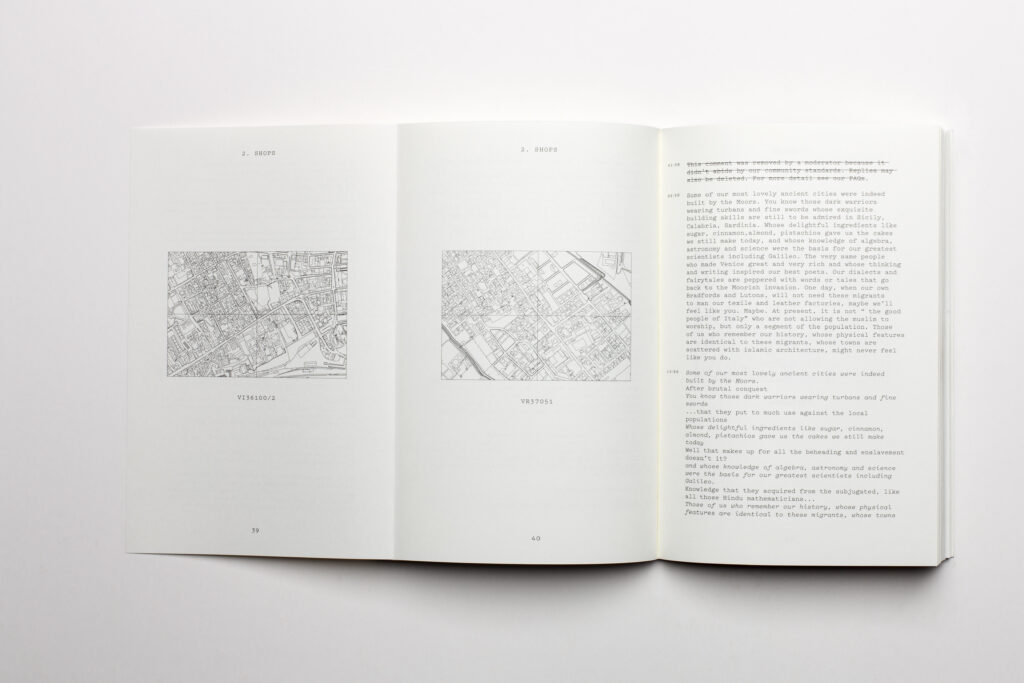
RORHOF, 2014. 6 x 9.5 (16 x 24 cm), 90 pages.
Edition of 300. Softcover with dust jacket.
ISBN 978-88-909817-3-9
Degiorgis’s work in publishing raises questions as to what we consider an adequate form of reception—questions that are also pertinent to Green’s limited editions and Singh’s potentially exclusive distribution strategy. The argument that reception must be centered on the experience of the book itself is a position that may extend existing privileged audiences and sideline the vast potential for alternative and distance reading. Is a reading of Chairs through interview, video, and book photographs legitimate? Is one week with a complex work enough to form a credible reading? It is far from a simple issue and was raised in the Guardian comments in relation to Degiorgis’s work: “How many of you did actually see the book that is being discussed here?”[36] This tension is indicative of a struggle to locate “the work,” which is compounded by the photobook’s increasing proximity to conceptions of the artists’ book and a narrative that emphasizes ownership or else haptic encounter not so much as the ideal reading but as the only reading. Certainly this close relationship to the book is powerful, but it is worth considering how a concentration on reception might permit for a broader view and an expanded conversation and impact.
What happens when a more intimate, thoughtful, and enduring understanding comes from mediated discussions of an exhibition, rather than from a direct experience of the work? Is it incumbent upon the consumer to bear witness, or can one’s art experience derive from magazines, the internet, books, and conversation?[37]
Green, Singh, and Degiorgis, in their own ways, inscribe the work of facilitating and recording reception into the longitudinal act of publishing. They understand how a handful of books can be helped to leave a mark far larger than their footprint. They recognize the book is a site of meaning that can be re-presented and re-mediated without a loss of energy. They counter the idea of publication as the end of publishing, and they do so without diminishing the latent future-oriented qualities of bound work. The hazy and chimerical nature of readers and their readings become a little more real.
Encouraging, and making visible, the long and slow work of publishing can be seen as a collective and connected endeavor. When institutions begin to question the accessibility of works, when prestigious awards explicitly consider post publication efforts and impacts, and when reviews confront price, visual language, and relevance beyond medium expectations, publication trends will shift. Perhaps then publishers and other makers will gain a reputation not only for print quality, intricate design, or gallery connections, but for bespoke, book-by-book strategies that amplify and activate reception now and in the future.
- (1)
Pia Pol and Astrid Vorstermans, “The Now of the Future,” in Futurebook(s): Sharing Ideas on Books and (Art) Publishing, ed. Pia Pol and Astrid Vorstermans (Amsterdam: Valiz, 2023), p. 9.
- (2)
I have previously written about a lack of appetite for reading and reception of the photobook, focusing on the difficulty of the task, the need to hold space for reading, and a lack of appetite given the security of speaking about production. See “A Turn to Reception: Readers and Reading in the Contemporary Photobook Ecology,” Compendium: Journal of Comparative Studies (2022), pp. 68–86.
- (3)
Paul Edwards, “Introduction: The Photobook as Confluence,” in The Photobook World: Artists’ Books and Forgotten Social Objects, ed. Pael Edwards (Manchester: Manchester University Press, 2023), p. 3.
- (4)
Bruno Ceschel in Self Publish, Be Happy: A DIY Photobook Manual and Manifesto (2015), p. 502: “A book is very much like a message in a bottle: as soon as it starts circulating, who knows where it is going to go, who is going to see it, and when.”
- (5)
Silja Leifsdottir, “The Golden Record,” in Photography Bound: Reimagining Photobooks and Self-Publishing, ed. Antonio Cataldo and Adrià Julià (Milan: Silvana Editoriale, 2023), p. 61.
- (6)
Martin Parr, “Preface,” in Martin Parr and Gerry Badger, The Photobook: A History Volume I, (London: Phaidon, 2004), p. 4.
- (7)
Walter Costa, “Break the Cycle: Latin American Photobooks and the Audience,” Trigger (2019), p. 88.
- (8)
Matthew Stadler, “The Ends of the Book: Reading, Economies and Publics,” in Publishing Manifestos (Miss Read, 2018), pp. 118–27.
- (9)
Works can do both. Emma Lambert’s Where Are You Local? was first realized as a collaborative publication (2022) formed by a series of poster pages, which the reader could dismantle and rebuild at will. The project has encouraged its readership to reflect on their experiences of “local” and is entering a second stage in its iterative life with new collaborations emerging from the first work and conversations it sparked. The project’s tagline asks the reader to “read, unfold, curate, reassemble, contribute.”
- (10)
Dayanita Singh, Chairs (Boston: Isabella Stewart Gardner Museum and Steidl, 2005).
- (11)
Nicolò Degiorgis, Hidden Islam: 479 Comments (Bolzano-Bozen, Italy: Rorhof, 2014).
- (12)
An hourlong seminar, a week-long subject of study, or a “book of the month.”
- (13)
Tamsin Green, “Info,” Manual Editions, 2024, https://www.manualeditions.com/info.
- (14)
Kim Shaw and Tamsin Green, “This Is How the Earth Must See Itself,” Photomonitor, 2021, https://photomonitor.co.uk/interview/this-is-how-the-earth-must-see-itself.
- (15)
Available to purchase today for £180
- (16)
An increasingly uncommon experience given public libraries’ adoption of digital RFID and NFC tags.
- (17)
Something Green is keen to emphasize is not encouraged with her library books.
- (18)
Michael Warner, “Publics and Counterpublics (Abbreviated Version),” Quarterly Journal of Speech 88, no. 4 (2002): p. 413.
- (19)
Simrat Dugal, “Chairs,” in Dayanita Singh: Book Building, ed. Nayantara Patel and Simar Puneet (Göttingen: Steidl, 2022), p. 91.
- (20)
Dugal, p. 91.
- (21)
Dugal, p. 91.
- (22)
Benjamin Thorel, “#86/87 Our Book Work and Why We Do It,” in Publishing Practices, Publishing Poetics, ed. Jonas Magnusson and Cecilia Grönberg (Stockholm: OEI, 2020), p. 117.
- (23)
Peter Biľak, “Social Distribution Revisited,” Works That Work, November 30, 2015. https://worksthatwork.com/blog/social-distribution-revisited.
- (24)
Elaine W. Ho, “Getting a Move On: A Logistics of Thought Towards Print and Publics,” in Publishing as Method: Ways of Working Together in Asia, ed. Lim Kyung Yong and Helen Jungyeon Ku (Seoul: Mediabus, 2023), p. 217.
- (25)
Dayanita Singh, Museum Bhavan (Göttingen: Steidl, 2017).
- (26)
Dayanita Singh, House of Love (Cambridge, MA; Santa Fe; New York: Peabody Museum Press, Radius Books, 2011).
- (27)
Nicolò Degiorgis, Hidden Islam (Bolzano-Bozen, Italy: Rorhof, 2014).
- (28)
In total, 5,000 copies of the book have been made.
- (29)
Sean O’Hagan, “Hidden Islam: 479 Comments: The Photobook That Contains No Photos,” Guardian, January 12, 2015. http://www.theguardian.com/artanddesign/2015/jan/09/hidden-islam-479-comments-nicolo-degiorgis-sean-o-hagan.
- (30)
Degiorgis, Hidden Islam: 479 Comments.
- (31)
Degiorgis, Hidden Islam: 479 Comments.
- (32)
Degiorgis, Hidden Islam: 479 Comments.
- (33)
Degiorgis, Hidden Islam: 479 Comments.
- (34)
Nicolò Degiorgis, “Books as Spaces Within Spaces,” in Why Exhibit?: Positions on Exhibiting Photographies, ed. Anna-Kaisa Rastenberger and Iris Sikking (Amsterdam: Fw:Books, 2018), p. 242.
- (35)
The reimagining of work in varied spaces is a common thread through all three practitioners, with Singh shying away from any sort of formula for display (or publication and distribution) and Green seeking ways in which books themselves can be presented as “deconstructed wall-mounted objects” that can be “disassembled and reused or recycled.”
- (36)
Username jofo1981 in O’Hagan, “Hidden Islam.”.
- (37)
Seth Price, Dispersion, ed. Seth Price (2007).